
Surrendering to Earth’s Intelligence
The living world invites us to more than simply paying attention…

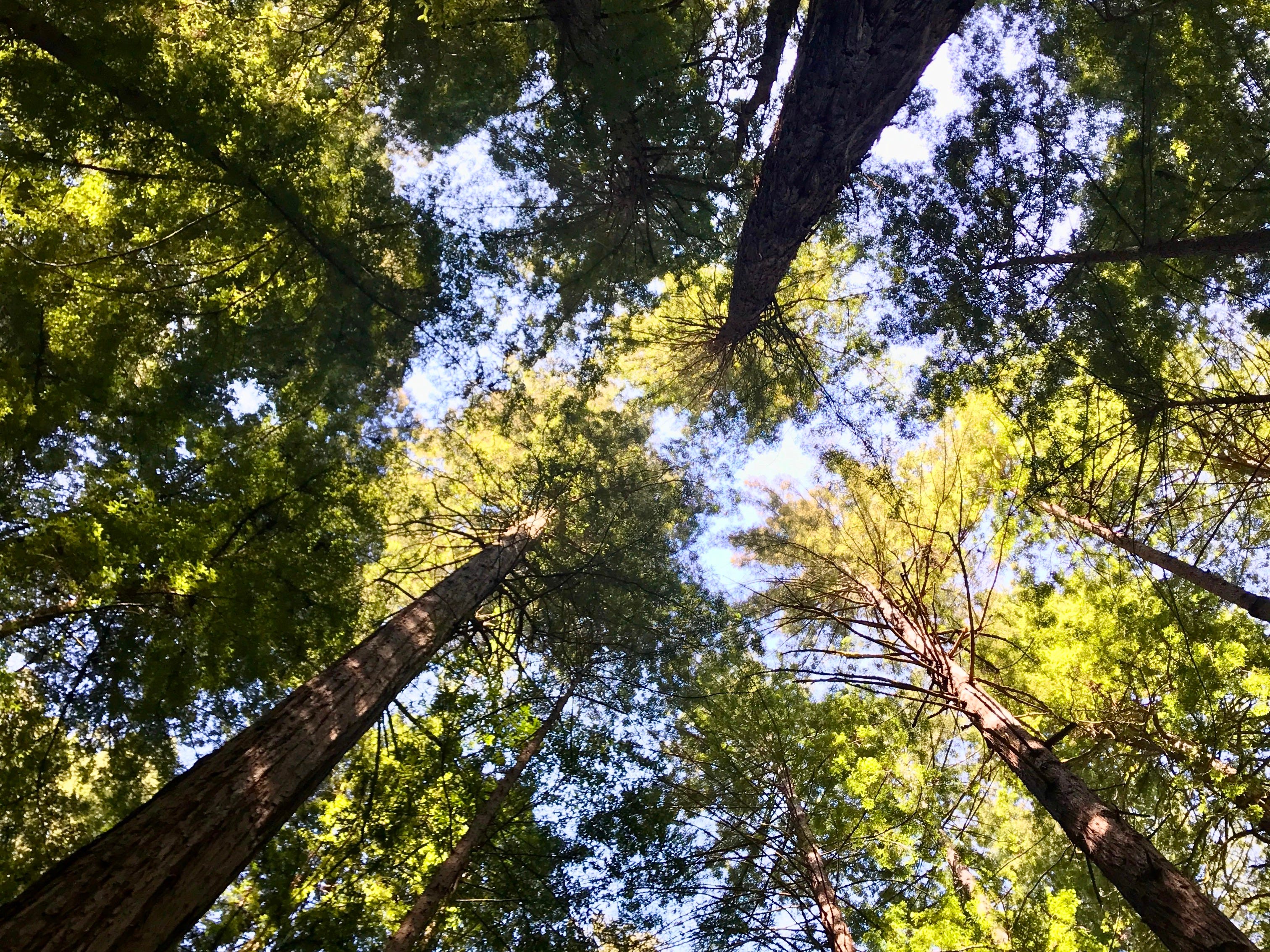
“If we surrendered
to earth’s intelligence
we could rise up rooted, like trees.” – Rainer Maria Rilke
Have you experienced a single word suddenly grabbing your attention? A simple word that had flown by with barely a ripple now parts the air, burrows into your jumbled thoughts, and stirs you from what has felt like a perpetually dazed state? Even after that initial surprise, the word persists, now showing up with increasing frequency in what you read and hear.
Surrender. That word. A call to action – or is it inaction? – is disturbing my routine.
Of course, words carry multitudes of meanings so let me explain the context in which I am reflecting on surrender. I wonder: What does it mean to surrender to the wisdom of the living world? Surrender to the genius of the more than human community? Surrender to the intelligence of Earth? And why would it matter?
For decades I’ve invited pilgrims, retreatants, and readers to “pay attention,” “tune your senses,” “open to wisdom,” “listen from your heart.” I don’t recall ever suggesting that they surrender to the wisdom of the ecosystem, of the air we are breathing, the water coursing through us on its journey from and to other lives and times. What have they been missing? What have I been missing?
So, I begin this walk, gazing up to the tips of the branches above, feeling soil beneath my steps, breathing in the air of Earth, simply holding the thought “surrender.” An intention to surrender lands differently for me than my usual practice, placing me more firmly in a space of not knowing. Reminding me that I’m not even clear what questions to ask.
I consider how I often I ask the trees to show me what it means to be resilient, seek guidance from the plants who know life in the darkness, wait for river to share what it means to be on an ever-changing journey. Too often I am an impatient child, persistently requesting what I want – or what I think I need. Even when I have politely introduced myself and requested permission to speak, I’ve been centering myself in the conversation with more than human lives. It’s all about me.
I find that I am struggling to explain, trying to write at the edge of my understanding. Yet it feels as if there’s something there for me. Not just a word stuck in my thoughts, but a concept tugging at my soul. A request for something deeper that takes me beyond “me.”
The poet Rainer Maria Rilke has much to say about surrender. And perhaps that’s why so many of his poems have caught my attention over the years.
In “Gravity’s Law,” Rilke notes that we all are being pulled into the “heart of the world.” Humans alone are determined to resist that call: “Only we, in our arrogance,/ push out beyond what we belong to/ for some empty freedom.” In this resistance, we reject the gift offered from the living world: the capacity to rise up rooted, like trees. When we refuse to surrender to wiser beings, our knowing cannot extend beyond our own limited human experience. “Instead we entangle ourselves/ in knots of our own making/and struggle, lonely and confused.”
Constrained by my own refusal to learn from elders with generational wisdom that far surpasses the span of humanity, I am unable to conceive even the questions that might free me from my limitations. I ask how to become the human version of a tree without understanding that I might be a forest.
As is so often the case, once you start pulling at the threads of an idea, other writers cross your path to help you push the edges. The amazing writer Chloe Hope in Death & Birds shows how a condor surrenders to the world in which it flies – and then she writes of the ultimate surrender to which we will be called:
“These magnificent beings take to the skies, and surrender to the currents they find there. They do not fight the air they’re met by, nor wish for better winds. They sense what is, and answer in accordance—and the world, thus met, holds them aloft. Their surrender is not capitulation, but an active and intelligent response to the world exactly as it is. And their radical trust ignites my own.
Surrender is exquisitely difficult—for me, at least—and it seems that no matter how many times I manage it, it never becomes something that I know how to do. I’ll mither and loop, all while knowing there is an alternative, but it somehow feels out of reach. I wonder whether the act of letting go, of yielding to the very is-ness of things, tends toward rocky terrain because some part of us knows that a day exists, suspended in the geography of the future, where the final task to be asked of us will be that very thing. Each time I open my arms and tilt my head to the sky, and meet the world on its own terms in a posture of vulnerability, I am preparing for—and speaking to—my ultimate surrender.”1
Yielding to the very is-ness of things. That feels so far beyond watching, attending, listening…. Can I, should I, lean into the wind and trust it to carry me?
I return to Rilke who seems to be my guide toward edges. In his poem “The Man Watching,” he writes:
What we choose to fight is so tiny!
What fights us is so great!
If only we would let ourselves be dominated
as things do by some immense storm,
we would become strong too, and not need names.
When we win it’s with small things,
and the triumph itself makes us small.
What is extraordinary and eternal
does not want to be bent by us.
Wrestling with that beyond our knowing. How often not knowing stops me. It nearly stopped me from writing this essay. I’ll bet you can tell that I’m at the edge or even beyond. And still, there’s an excitement in surrendering to the wild energy of the storm, allowing the possibility that we might be kneaded and reshaped by harsh and lovingly wise Sophia.
I’m back to what I was trying to express in the writing of Earth & Soul.2 A sense that in the depths of our soul, our truest self awaits rediscovery. That the journey to recover our soul gift for the world is also the path to re-membering our place in the web of life. To grow by “being defeated, decisively, by constantly greater beings.” Whew! That’s a big ask!
In “Pain, Joy, Hope, Repeat” Hopecology Substack author, Andrea Joy Adams wrote:
“In the face of difficulty, it’s tempting to think we can optimize our way out of it, to “fix” the problem. I certainly did: in grad school, I added two triathlons, extra lecturing jobs, and elaborately disordered eating habits to my to-do list, thinking these things would help.
They did not.
Optimization is often not the solution. Let’s face it: aren’t challenging times hard enough? What would happen if we just let pain and difficulty do its transformational work on us? Maybe the weathering is the integrity.”3
And then she goes on to quote Chloe Hope - as I just did.
****
Something is stirring among us, an invitation to surrender to the wisdom of the world and allow it to transform us. We are called to be more than an observer of life. We are urged to open-hearted engagement with the fullness and mystery of what exists beyond what we can ever comprehend.
So I sit, hoping to quiet my busy mind. Letting go. Letting go. Letting go.
I said to my soul, be still, and wait without hope
For hope would be hope for the wrong thing; wait without love,
For love would be love of the wrong thing; there is yet faith
But the faith and the love and the hope are all in the waiting.
Wait without thought, for you are not ready for thought:
So the darkness shall be the light, and the stillness the dancing. – T.S. Eliot
****
Surely I need not say that this essay is not about yielding to the malevolent machinations of greedy individuals and groups seeking to meet their narcistic needs for power and domination. This is not about submitting to hopelessness and despair (though of course we want to notice and name when those feeling arise).
Listen again to Rilke:
“If we surrendered
to earth’s intelligence
we could rise up rooted, like trees.
Rooted. Like coast redwoods whose roots intertwine to keep the entire community upright during raging storms. Rooted. Like an old growth beech forest, sending nutrients to those with less access to water or sunlight so that the whole forest thrives. Rooted. Like the boreal forest where birch and fir trade nutrients as their needs change with the seasons. Rooted. Like an ecosystem that acts as one, communicating and responding in complex reciprocity with all beings of the forest, and indeed all Earth systems.
From Earth’s intelligence, we rise up. From within the wisdom of deeply rooted forest, we rise up.
***********************
*****
Join us this week on Substack Live for another Listening to Earth!
On Thursday, March 12 at 4:00 pm EST, Camilla Sanderson and I will be speaking with Julie Gabrielli about her novel, FLUX, that she recently serialized on Homecoming. We’ll talk about the impulse to write with a sense of urgency and explore how slowing down and listening leads to surprising places. We’ll explore the themes and main character in FLUX and the urgent messages they hold for us in these times. We’d love for you to join us.
Click this link to add it to your calendar.
****
Join me in person for an upcoming retreat:
Earth Awareness: Deepening Connections, Weaving Reciprocity
Saturday, April 25, 2026
Time: 9:30 - 4:00
Location: Bon Secours Retreat Center, Marriottsville, MD
Leader: Leah Rampy
On this day-long retreat we’ll slow our busy minds, tune our senses to the more than human life around us, and remember that all are held within a living, sacred web.
Early Bird registration is available until 3/25/26.
****


You’ll want to share this beautiful book with a child you love or gift it to your local library. Sing up the Earth by Cheryl Hellner, illustrated by Merce Tous.
*****

Leah Rampy. Earth & Soul: Reconnecting amid Climate Chaos. Bold Story Press, 2024.

I love this Leah. Also known as the Dance of Will and Surrender with the Divine🥰
Your honesty about writing at the edge of understanding is beautiful too. Perhaps that space of not-knowing is itself a form of surrender. 🌿
Beautiful and thought-provoking, Leah. Thank you! It reminds me of the Zen master Seung Sahn, who taught the concept of "don't-know mind." Powerful practice!