

It’s exciting when posts align without any means of coordination - except, of course, the energy of the universe! If you haven’t come across Following the Fungi: Cultivating Unseen Connections by Wendy McCaig ; Earth Dreams Us by Julie Gabrielli ; and Truth-Telling Trees by Marisol Muñoz-Kiehne , I encourge you to check them out. I found these posts particularly inspiring and relevant to our conversation.
In my last post, Journeying Toward the Great Turning Part 2, we discussed the importance of imagination and creativity as we seek to transform, turning aside from destructive “business as usual” and charting a course toward a future of mutual thriving. Yet freeing ourselves from the grip of habituated ways of thinking and acting is extremely difficult. To turn toward a deeper level of personal and collective consciousness requires more than accumulating experience and knowledge.
In many ancient stories of change, wise elders were there to initiate the people into dreaming a new world. Alas, few such elders are available in the majority of our communities today. Too many of us have become “old” without becoming “elders.”
I refuse to believe that all is lost, however, for I am confident that wisdom and inspiration need not come solely from the human community. Indeed, wise elders may be as close as our own backyard, nearby river, meadow, or forest. They may be waiting for us right now with the very gifts we need to lead us to the future.
If you’ve ever participated in a seminar or retreat I’ve offered, you have doubtless heard more than one story of trees and forests. I love to talk about how trees share food and water, communicate with each other, prepare for difficult times, and offer gifts to people and planet throughout their lives - and even in death.
In our years of researching, teaching, and writing about trees, my friend, colleague, and coauthor Beth Norcross and I have been astounded by all that trees offer: “We came to understand that trees have a unique wisdom that can provide important inspiration, comfort, and guidance for our times —lessons in resilience, adaptation, renewal, reciprocity, and hope.”1 I believe all that is true.
Let’s see if we can open to wider and deeper levels of wisdom as we explore the interactions of and even the boundaries between trees and forests.We’ll begin in the vast, beautiful, and at-risk boreal forests.
“There is something profoundly wrong with a solitary pine.” ~ Ben Rawlence
Author Ben Rawlence traveled from Scotland, Norway, and Siberia to Alaska, Canada, and Greenland to study the taiga or boreal forests – the world’s largest land biome. The Treeline chronicles his journey. I was taken by the story of Scots pines.
In a healthy forest, older pines send support to young saplings via the underground mycelial network. When the saplings mature into hearty adults, they take on the mantle of providers, sending nutrients to aging pines. (A lesson any aging parent might want to share with their children!) Thanks to this approach to caring for the whole, pines can live six to seven hundred years in a forest.
Sadly, but perhaps unsurprisingly, lack of community takes a toll on the wellbeing of trees. Lone pines die much earlier than those in a forest. Because of the massive extraction of trees from 1690 to 1812, Scotland’s forests were decimated. The remaining, isolated grandmother pines live only half as long as they might if they lived within a healthy forest.
Rawlence pondered what this might mean to pines:
“Lone trees are prone to sudden dying before the end of their normal life expectancy. Could it be that these matriarchs of our oldest forests, these steward of our ancient ecosystems and midwives of so much industrial wealth are, in their old age, lonely? Native American stories tell of solitary trees ‘speaking’ to humans of their loneliness, asking people to plant them neighbors….. Are they mourning the ghost of the forest?”2
Clearly trees embrace and thrive in collaboration and interdependence. But that’s not all. It’s as if trees long to be forest.
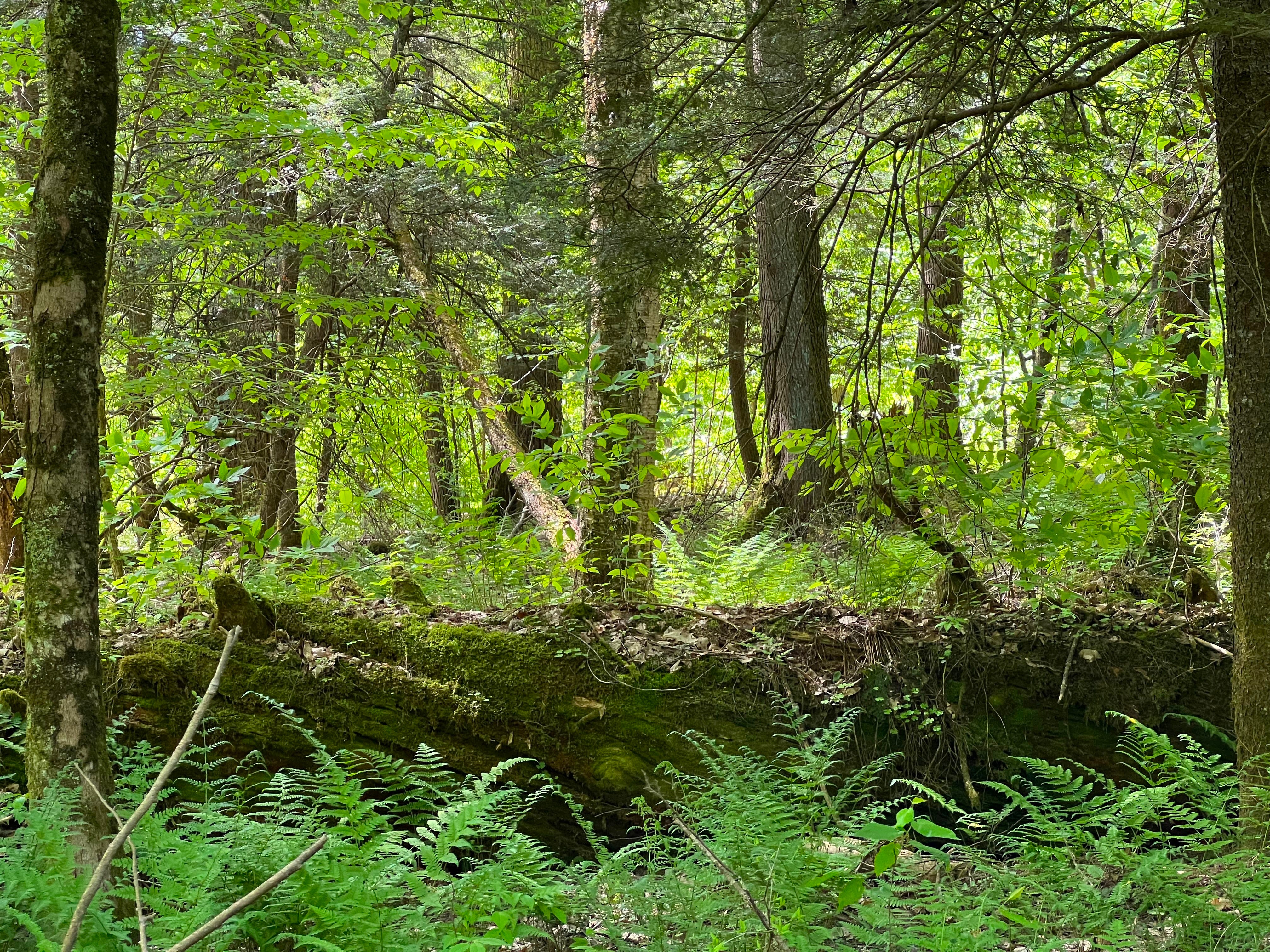
Imagine what it would be like. Intertwined in life-giving exhange with the multitude of diverse life underground. Trunks, branches, and leaves sharing food, habitat, and new life with insects, birds, mammals, reptiles. Dancing with sun to keep alive the carbon cycle. Cooling the air through evapotranspiration that seeds the clouds and brings rain. Cleaning and storing the rainfall, then releasing it to other plants and underground rivers. Purifying the air with all those beautiful leaves you have birthed, then releasing them each autumn to cover the forest floor where they will decompose and make rich soil from the nutrients you have created.
Can it be that trees long to become forest to fulfill their greater purpose? Not a monoculture plantation - that is NOT a forest - but a beautifully diverse, intergenerational, multi-species web of sacred beings, gifting life and maintaining the health of Earth’s systems.


“A forest is a single organism wired for wisdom and care.” – Suzanne Simard
Another example: If we look carefully at an old growth beech forest, we might notice areas of forest that are heavily shaded. It would be surprising if trees with little access to light were as healthy as their sunlit neighbors who are able to photosynthesize more freely. We might spot areas of forest where rainfall struggles to reach tree roots or where water flows less freely. Surely those trees would be at a strong disadvantage.
The old story of “survival of the fittest” would predict that forests would take advantage of these strategies to thin out competition. Yet studies have found that seemingly disadvantaged trees are photosynthesizing at the same rate. How is this possible?
Life-giving gifts of nutrients and water are redistributed between stronger and weaker trees by the underground fungal network so that trees with limited access still grow and thrive, benefiting from collective community.
Here’s how forester and author Peter Wohlleben described this collaborative community:
“When trees grow together, nutrients and water can be optimally divided among them all so that each tree can grow into the best tree it can be. If you ‘help’ individual trees by getting rid of their supposed competition, the remaining trees are bereft. They send messages out to their neighbors in vain, because nothing remains but stumps. Every tree now muddles along on its own, giving rise to great differences in productivity. Some individuals photosynthesize like mad until sugar positively bubbles along their trunk. As a result, they are fit and grow better, but they aren’t particularly long-lived. This is because a tree can be only as strong as the forest that surrounds it. (Emphasis mine.) And there are now a lot of losers in the forest. Weaker members, who would once have been supported by the stronger ones, suddenly fall behind. Whether the reason for their decline is their location and lack of nutrients, a passing malaise, or genetic makeup, they now fall prey to insects and fungi.
But isn’t that how evolution works? you ask. The survival of the fittest? Trees would just shake their heads – or rather their crowns. Their well-being depends on their community, and when the supposedly feeble trees disappear, the others lose as well. When that happens, the forest is no longer a single, closed unit.”3
When I read this a few years back, it shook my world. I was struck by the thought that there is no division. Tree and forest are one.
Our “business as usual” story of competition, power over, survival of the fittest, individuality-at-any-cost does not play in the forest. It is not playing well in our lives. Not only are we making incredibly harmful decisions on behalf of forest communities, we have taken what we assumed were the “lessons of nature” and applied them to our lives with equally disastrous results.
Why do we fail to take into account that our bodies have no discrete boundaries? Our breath wanders on the wind to engage with trees and plants; rivers and rain course through us and then are eliminated and evaporated into Earth’s flow; sunlight transforms to life-giving sugars to feed the bodies of trees, plants, mycelia, and us; trillions of bacteria, fungi, and viruses roam from eyelashes to gut, mouth, skin – to and from soil and surfaces – coming, going, developing, dying without our awareness - digesting, regulating, protecting, giving form to emotions, health, life.
Are we tree or forest? Yes.
There is no individual “me.” I am tree, forest, soil, sky, river, Earth, cosmos.
Adhering to the myth of separation frays the threads connecting us to the web of life and feeds the great unraveling.
We hold on to the story of individualism when the truth is we are Pando. Pando is a living system of aspen in Utah. It is the world’s largest tree by measures of weight, landmass and species. What looks like 47,000 individual trees are actually genetically identical stems of a single tree spanning 106 acres.
We look at Pando and see what we think we know. We accept what fits our story of separation and othering.
It’s time to sit by the roots of a tree, nestle ourselves next to a trunk, gaze into a canopy, and ask these lives to challenge and teach us.
Aspen, Oak, Pine, Beech, Hickory, Hemlock. Left to thrive naturally, trees demonstrate that tree, forest, underground network, water cycle, carbon cycle are unified. Not one “thing” nor the other. Not sometimes tree and sometimes forest. Both. No separation. Interwoven in communion so that “no thing” can be picked apart. Not a resource, not timber. A wise and animate being whose gifts to Earth unfold before us as we open to new ways of understanding.
And this sacred, miraculous, highly complex being we call forest welcomes us to learn from them. Tree forest can become our teachers and soul guides.
Tipping the scale toward a future of mutual thriving will require a depth of wisdom beyond what any individual possesses. It’s trite but true that we cannot create steppingstones toward more vibrant, live-giving possibilities from the world views and stories that brought us business as usual. How fortunate that we live in a world of wise and generous Earthlings who originated long before our species and can share from a rich heritage of resilience and thriving.
If we can humble ourselves and hone our awareness to hear their unique voices, forest may teach us to embrace our role as the younger species of Earth and claim our place in the family of things.
Mark your calendar to continue these conversations:
Our next online monthly gathering of Church of the Wild Earth & Soul will be on Sunday, September 6, 3-5pm EDT on Zoom. I’m still refining the theme and accompanying content, but things are stirring around the pain and honor of bearing witness to the many losses in the living world around us. It would be great to have you in the conversation.
Our in-person seasonal gathering for Church of the Wild Earth & Soul will occur on Sunday, September 20, 2-6pm, at Shepherd’s Spring Retreat Center, Sharpsburg, MD, just over the river from Shepherdstown. As we approach the autumnal equinox, we’ll harvest the gifts of the living world and acknowledge our gratitude. More information will be forthcoming via Substack, but if you’d like a personal email invitation when it’s ready, just let me know via the contact form on my website.
Additional Resources:
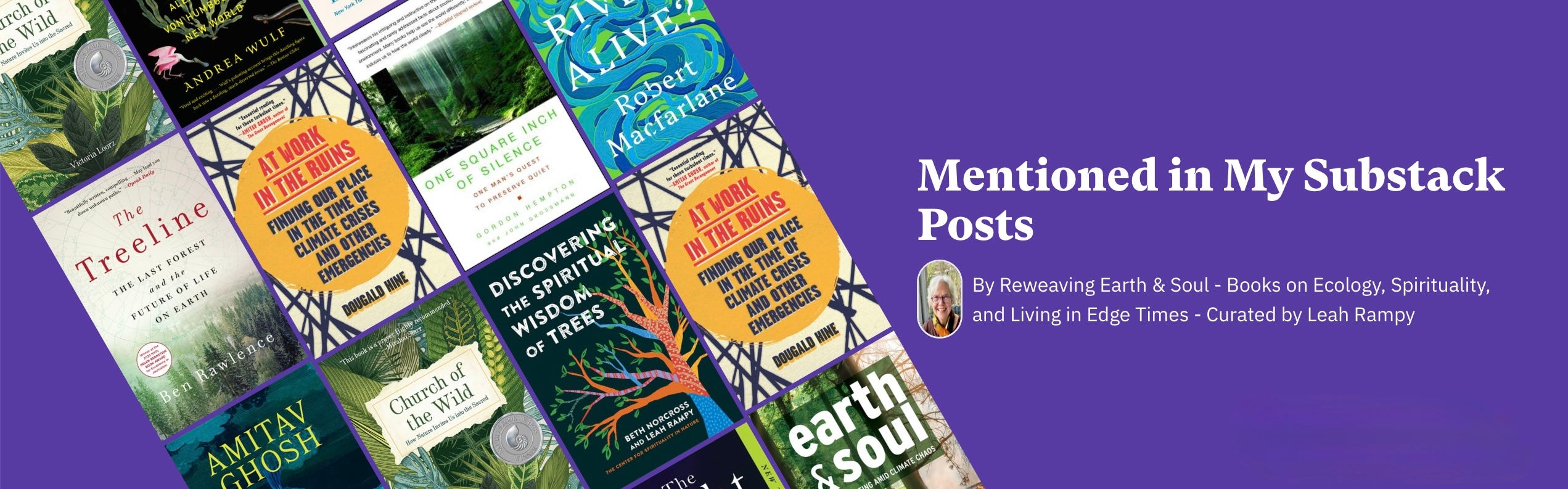
One of the joys of writing essays is sharing books and authors who illuminate our conversations. I’ve created a site on the non-profit Bookshop.org where I’ve curated books relevant to this Substack. You’ll find sections on Ecology and Spirituality, Trees, and books specifically mentioned in my posts. If you’re interested in knowing more about any of the books I quote or highlight, click the link below or those in the post.
~~~~~~
You can read much more about trees in Discovering the Spiritual Wisdom of Trees by Beth Norcross and Leah Rampy.
Ben Rawlence, The Treeline: The Last Forest and the Future of Life on Earth (New York: St. Martin’s Press, 2022), 17-18.
Peter Wohlleben, The Hidden Life of Trees: What They Feel, How They Communicate (Vancouver: Greystone Books, 2015),15–17.
Good morning, Leah☀️
I absolutely love that you wrote about "underground mycelial networks" and I love even more that this seems to be in the zeitgeist right now♥️🔥🙏
I also have a sense you'd love the book I'm reading at the moment Leah, "Our Ancestors Want Us to Be Mushrooms: Wisdom for Living in Balance with the Planet and Each Other" by Madison Murphy Barney.
Wise elders galore…
warmly wait in we-world’s woods.
Forests, faith-fuel full!
…
Loneliness drains life…
each Tree is forest is one.
Same for us saplings.
…
Separation, lie…
Pando shows/teaches real truth.
There’s no ‘I,’ ‘me,’ ‘mine’!